
Tool · Desktop · Windows · Single-file
AptaFold
DNA aptamer secondary-structure prediction with explicit Na⁺ / Mg²⁺ / K⁺ / Ca²⁺ / temperature inputs, motif-aware constraints, and G-quadruplex detection & rendering — built to replace m-fold / UNAFold for routine SELEX lab use.
MIT license · Installed and kept current through the AptaPilot Launcher
/ Introduction
What it does.
AptaFold predicts DNA (and RNA) secondary structure with the salt and temperature conditions actually used in aptamer assays. It pairs ViennaRNA's monovalent salt correction with a per-loop divalent callback for Mg²⁺ and Ca²⁺, and adds a G-quadruplex channel-binding term for K⁺ / Na⁺. The desktop GUI exposes every parameter you'd normally hide in a CLI, with motif-aware constraints (Loose-scaffold SELEX mode) and a layered G-quadruplex cartoon view for the topology you'd otherwise read off a paper.
-
Four-cation aware folding
Explicit
Na⁺,Mg²⁺,K⁺,Ca²⁺inputs with temperature — the only open tool we know of that touches Mg²⁺-vs-Ca²⁺ for DNA aptamers. -
G-quadruplex detection & cartoon
Detects G-tract motifs, scores topology under K⁺ / Na⁺ channel binding, and renders both axial (top-down tetrad) and side (layer-diagram) views via a DrawTetrado-style painter's algorithm. The main fold viewer also auto-switches to 3D when a G4 is found, with a
Flat ↔ 3Dtoggle. -
Four interchangeable engines
seqfold(pure-Python fallback),ViennaRNA(industry default, monovalent salt),ViennaRNA+Mg²⁺(experimental Mg²⁺ callback), and4cations DP(full four-cation experimental engine). -
Suboptimal-fold exploration
Wuchty-style enumeration of folds within
ΔEof the MFE, with a coverage cap and "show 10/20/30" controls — useful when the MFE alone hides the relevant conformation. -
Motif-aware constraints
"Loose scaffold (SELEX)" mode keeps the known fixed primer-binding region as scaffold and lets the random N region fold freely — a one-click constraint that matches how SELEX libraries are actually designed.
-
Multi-format export
PDF, PNG, SVG, JSON, CSV, and PPTX. Also includes a batch mode for running many sequences at once through the same parameter set.
/ Engines
seqfoldPure-Python fallback. No salt model. Useful when ViennaRNA isn't available.ViennaRNAIndustry-default thermodynamic engine with Lai et al. 2023 monovalent salt correction.ViennaRNA+Mg²⁺Experimental: ViennaRNA + per-loop Mg²⁺ callback (uncalibrated).4cations DPExperimental: full four-cation dynamic-programming engine (uncalibrated).
/ Usage
How to use it.
AptaFold ships as a single-file Windows executable (~114 MB). Download it, double-click — no installer, no extraction, no admin rights.
-
01
Download & launch
Click the download button above (
AptaFold-0.6.7-onefile.exe, 114 MB). Just double-click the downloaded EXE — it's a self-contained single-file build, no install step, no folder to manage. The main window opens straight up and shows the sequence box, ionic-condition sliders, engine picker, and fold buttons. First-run takes a couple of extra seconds while the bundle unpacks to a temp folder.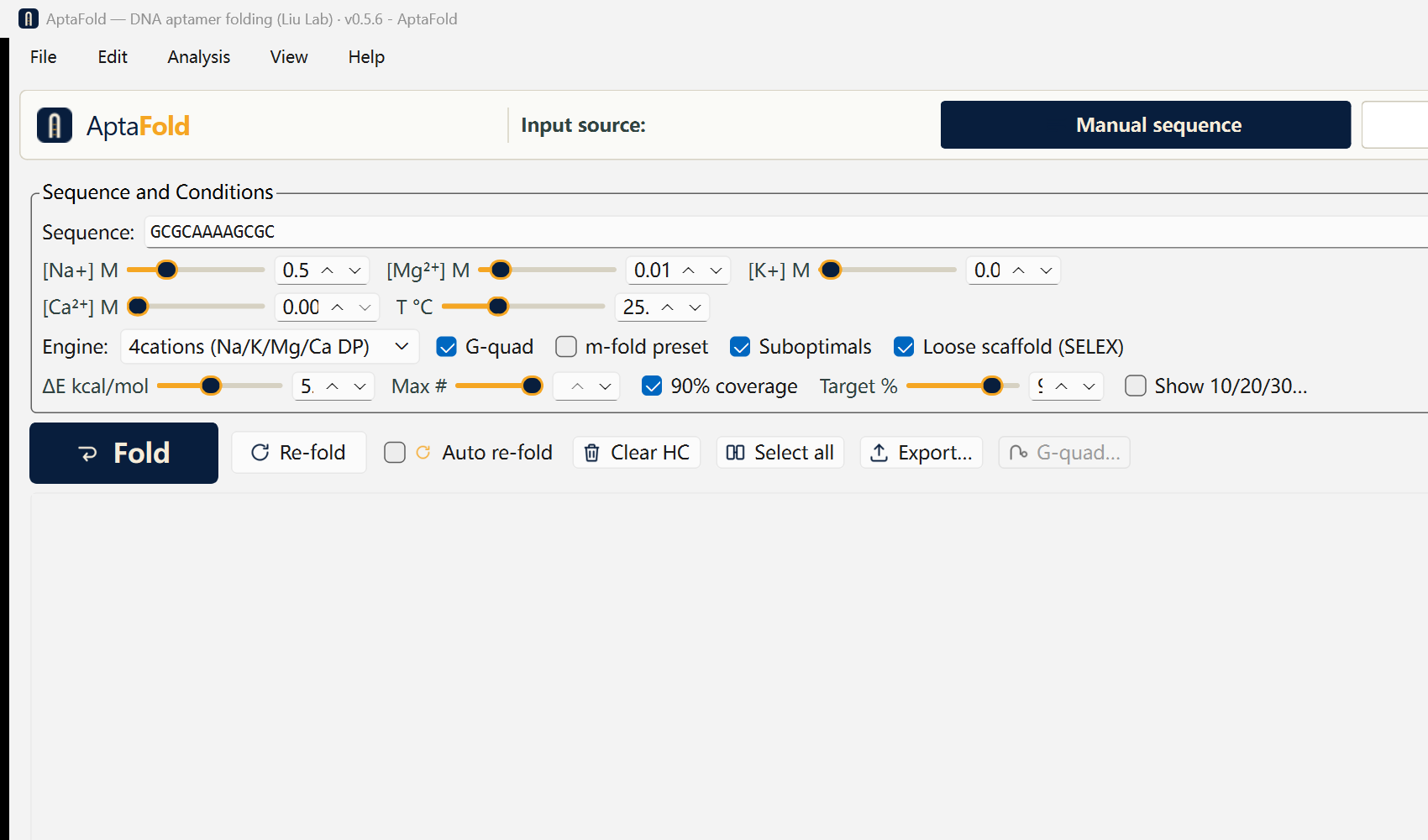
Fig. 01 — Main window -
02
Enter sequence & ionic conditions
Type or paste the sequence (ATCG / AUCG). Set
[Na⁺],[Mg²⁺],[K⁺],[Ca²⁺]in mol/L and the temperature in °C — defaults match a common SELEX selection buffer. Choose an engine (default4cations), and tick options: G-quad scoring, Suboptimals withinΔE, Loose scaffold (SELEX) for motif-aware constraints. -
03
Fold & read the result
Click
Fold. The result panel renders the secondary structure inline — base-pair stems drawn with Watson–Crick H-bonds in red, with position numbers, 5′ / 3′ termini, and ΔG values printed alongside each fold. You canRe-foldafter changing conditions without reloading anything.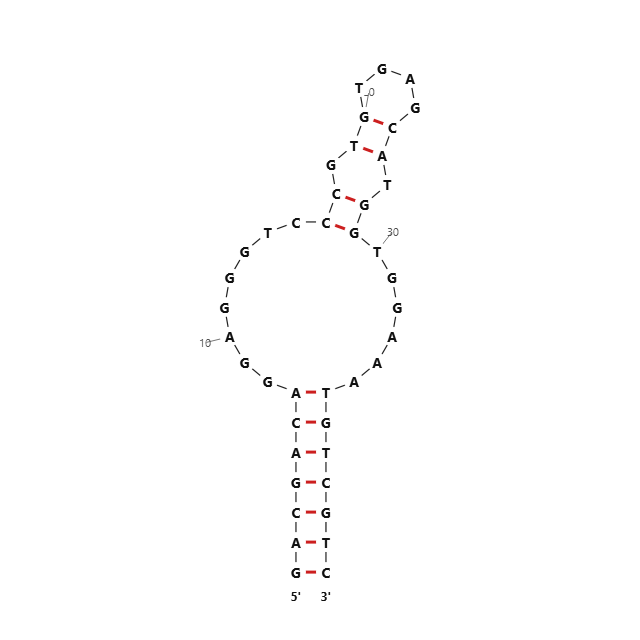
Fig. 02 — Fold render When the predicted fold contains a G-tetrad, AptaFold detects the G4 and defaults the result viewer to the 3D oblique-cube layout — the four G-tracts stack as parallel rails so the tetrad geometry reads at a glance. Click the
Flat ↔ 3Dtoggle in the bottom-left of the result panel to switch to the conventional flat secondary-structure layout (and back). The toggle is sticky per fold, so a re-fold preserves your view choice.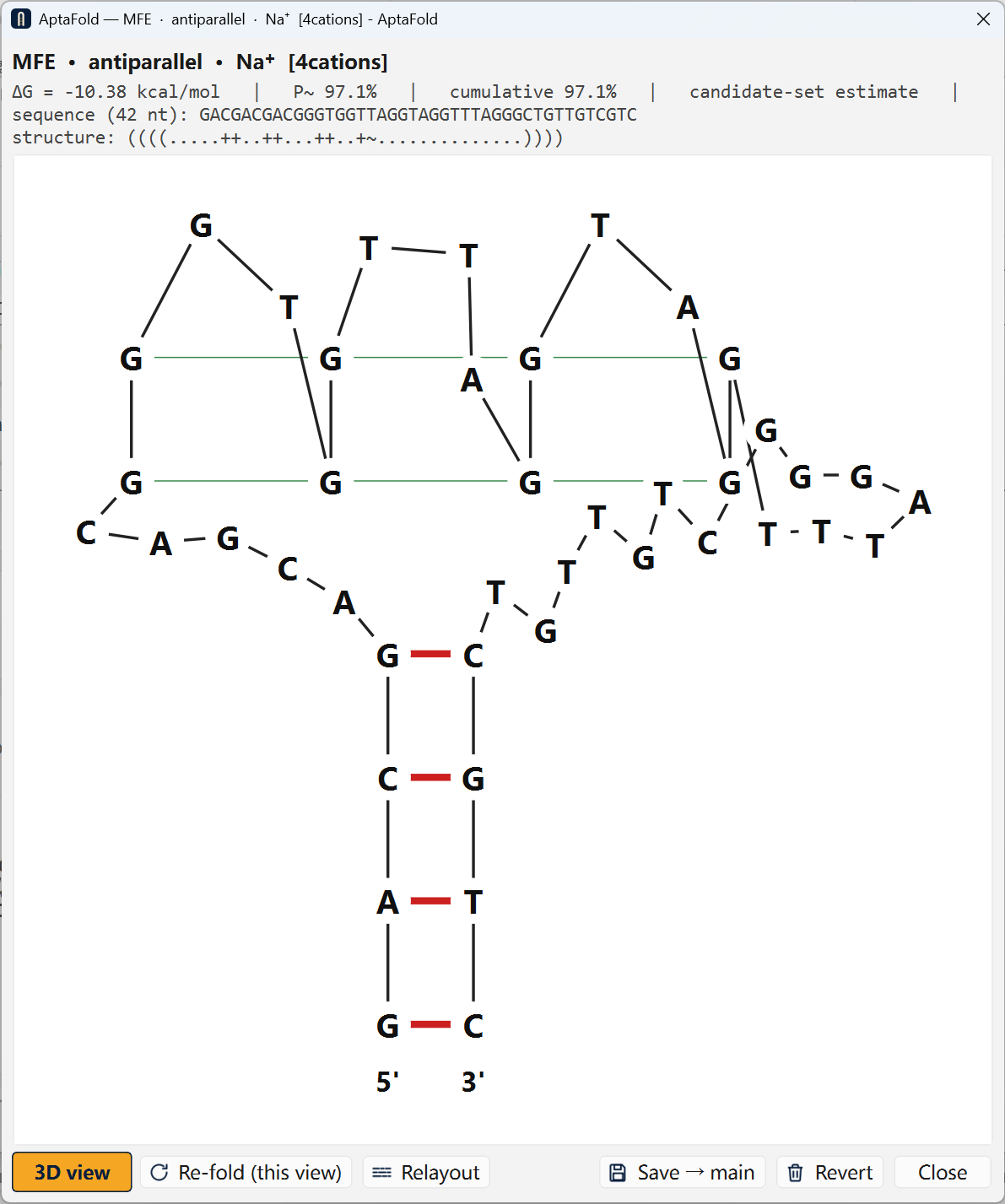
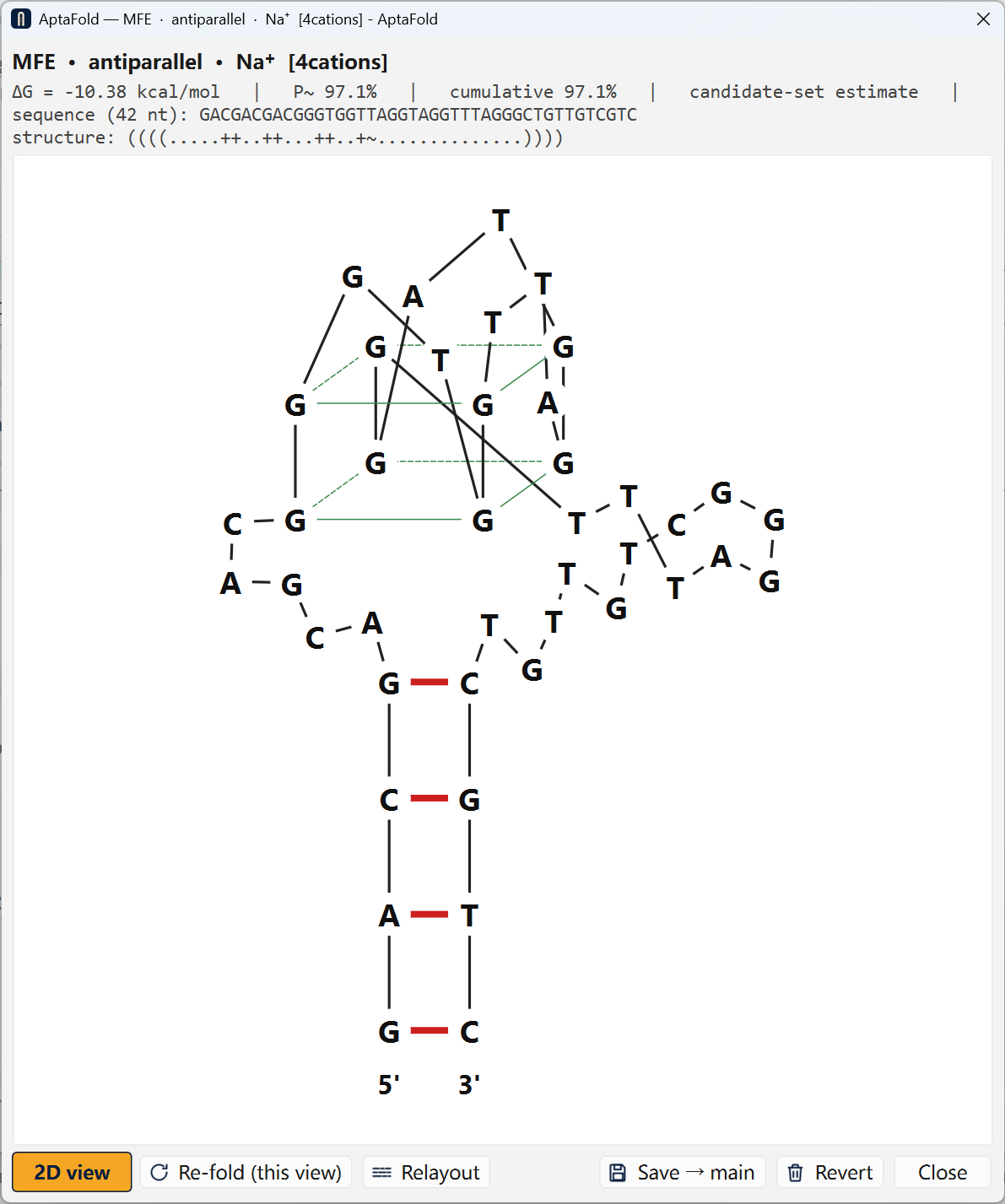
Fig. 03 — Same G4 fold, flat (left) vs 3D (right) -
04
G-quadruplex detail (if found)
If G-tract motifs are detected (and G-quad scoring is on), the
G-quad…button activates. Open it for a layered cartoon: axial view shows the tetrad from above with the central cation, side view shows tetrad stacking with propeller / lateral / diagonal loops drawn as external arcs. Each view exports as PNG / SVG / JSON / CSV.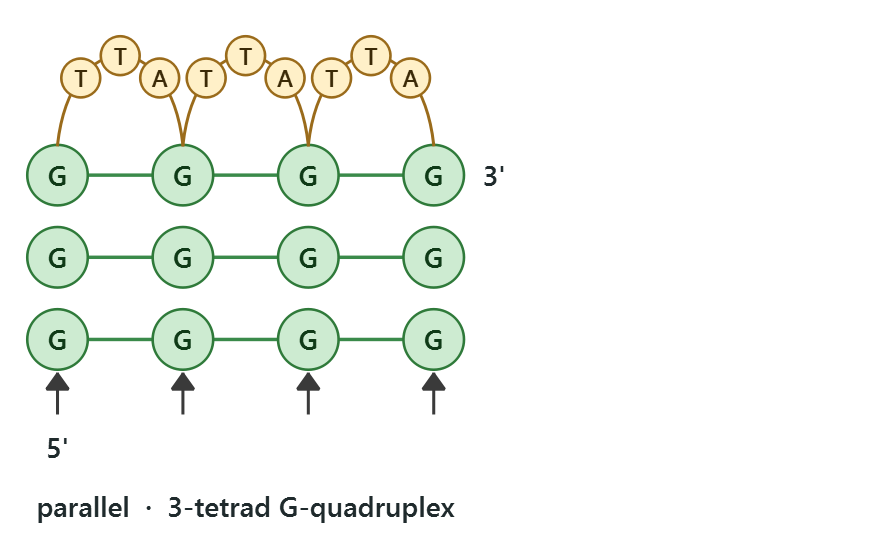
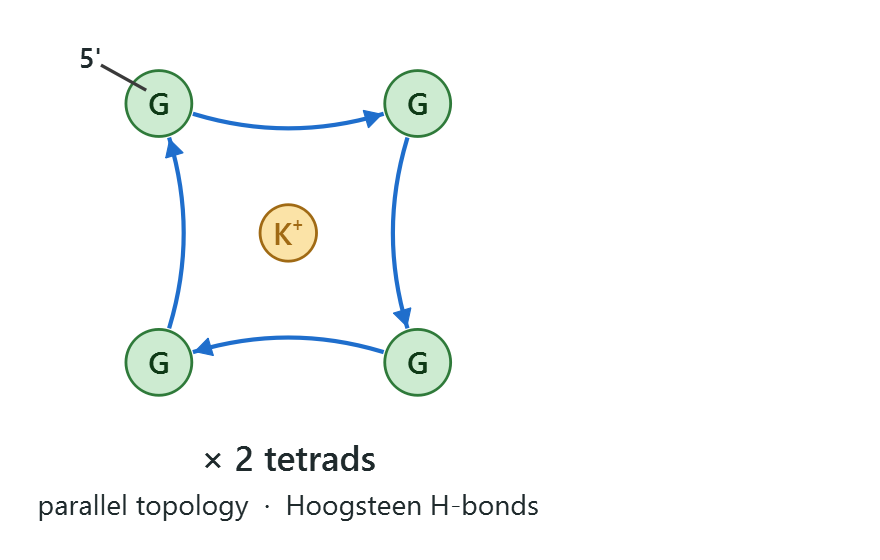
Fig. 03/04 — G-quadruplex side & axial
-
05
Export, or run a batch
Export…writes the current fold (or the whole suboptimal set) as PDF, PNG, SVG, JSON, CSV, or PPTX. For many sequences at once, switch the Input source fromManual sequenceto a CSV / Excel / Liu-Lab Aptamer Analysis output — AptaFold runs the same parameter set across all rows and exports per-sequence files.
/ Disclaimer
Things to know.
-
Engineering approximation, not calibrated physical chemistry.
The four-cation engine combines published trends (ViennaRNA monovalent salt correction, Tan–Chen tightly-bound-ion ideas, G-quadruplex channel-binding) into a single model. It is intentionally conservative and uncalibrated — use the output as a trend check and starting hypothesis, not as a quantitative Tm prediction.
-
Mg²⁺ / Ca²⁺ effects are experimental.
No open folding tool natively handles divalent cations — ViennaRNA's salt correction is monovalent-only. AptaFold's
ViennaRNA+Mg²⁺and4cations DPengines are experimental and pending the wet-lab Tm / ITC calibration described in the project'sEXPERIMENT_PLAN.md. -
Local processing, no telemetry.
AptaFold makes no network calls. Sequence input, folding, rendering, and exports all run locally. There is no auto-update check, no telemetry, no analytics.
-
MIT license · academic & non-commercial use.
AptaFold is released under the MIT license. Free for academic research, teaching, and personal use. ViennaRNA itself ships under its own permissive licence — see the bundled
licenses/notice. -
Provided as-is, without warranty.
Fold output is best-effort. Validate critical findings with independent methods — m-fold / UNAFold for Mg²⁺ comparison, CD / UV-melting for G-quadruplex topology. Bug reports: [email protected].
-
Cite if used in publications.
If AptaFold contributed to a published study, please cite: Zhang X. AptaFold (dna-fold), v0.6.7, Liu Lab, University of Waterloo, 2026. aptapilot.com/tools/aptafold.
/ Acknowledgments
Built on prior work.
Developed in the Bionanotechnology & Interfaces Laboratory at the University of Waterloo, led by Prof. Juewen Liu. AptaFold's identity, four-cation model, and G-quadruplex visualization grew out of the lab's daily SELEX / aptamer-folding needs — and out of the realization that no open tool actually handles the ionic conditions our buffers use.
-

Prof. Juewen Liu
Training data & support
Professor of Chemistry at the University of Waterloo. Tier 1 Canada Research Chair in Biosensors & Bionanotechnology. Provided the invaluable wet-lab training data and ongoing support that made the four-cation calibration possible.
-

Xiaohan Zhang
Author · Development · Formulas · ML
Postdoctoral researcher at the University of Waterloo under Prof. Juewen Liu. Main developer — designed and implemented the engine, derived the formulas, tuned the parameters, and built the machine-learning components of the four-cation model.
-

Yuanli Li
Data collection & cleaning
Third-year undergraduate in the Materials Nanoscience joint program (Beijing Jiaotong University × University of Waterloo). Built the training dataset — collected the literature and wet-lab measurements, cleaned them into the calibration-ready form used by the four-cation engine.
Standing on prior work. AptaFold also builds on the following projects and frameworks:
-
ViennaRNA · Lorenz, Hofacker, et al.
The industry-default RNA folding engine. AptaFold's default and
+Mg²⁺engines are both layered on top of ViennaRNA, including the Lai et al. 2023 monovalent salt correction. -
DrawTetrado · Zok et al. 2022
AptaFold's oblique G4 cube uses a painter's-algorithm depth ordering and propeller-loop arc style directly inspired by DrawTetrado (Zok et al., Bioinformatics 38:3835, 2022) — the purpose-built G-quadruplex layer-diagram tool that nailed the visual conventions.
-
Tan, Chen et al. — tightly-bound-ion model
The per-loop divalent callback design draws on the Tan–Chen tightly-bound-ion framework — the most physically principled treatment of Mg²⁺ in nucleic-acid folding, even though it had never been integrated into a distributable folding tool before.
Open-source libraries. AptaFold stands on the work of these projects — thanks to their maintainers:
- ViennaRNA
- seqfold
- PySide6
- NumPy
- matplotlib
- python-pptx
- openpyxl
- pypdf
- xlrd
- numba
/ FAQ
Questions people actually ask.
-
How is this different from m-fold / UNAFold?
AptaFold takes the ionic conditions of an aptamer assay as explicit inputs. Beyond ViennaRNA's monovalent salt correction it adds a per-loop divalent callback for Mg²⁺ and Ca²⁺, and a G-quadruplex channel-binding term for K⁺ / Na⁺. It also exposes every folding parameter in the GUI rather than hiding them behind a CLI.
-
Why do salt conditions change the predicted structure?
Duplex and loop stabilities are ion-dependent. Divalent Mg²⁺ and Ca²⁺ stabilise folded states differently from monovalent Na⁺, and K⁺ specifically stabilises G-quadruplex channels. Folding at default 1 M Na⁺ when your binding buffer is, say, 100 mM Na⁺ with 2 mM Mg²⁺ can return a different minimum-free-energy structure than the one your assay actually samples.
-
Does it detect and draw G-quadruplexes?
Yes. G-quadruplex detection is built in, and topologies are rendered as a layered cartoon view rather than left for you to read off a dot-bracket string or a paper figure.
-
Can I constrain folding to a known motif?
Yes — motif-aware constraints are supported through the Loose-scaffold SELEX mode, which is intended for libraries built around a fixed scaffold with randomised regions.
-
What platform does it run on, and what licence?
AptaFold is a Windows desktop application, installed and kept current through the AptaPilot Launcher. It is released under the MIT licence.
/ Citation
How to cite.
If this tool contributed to work you are publishing, a citation is the most useful thing you can send back — it is what keeps the tool maintained and lets other people find it.
APA
Zhang, X. (2026). AptaFold (Version 0.6.7) [Computer software]. https://aptapilot.com/tools/aptafold/
BibTeX
@software{zhang_aptafold_2026,
  author  = {Zhang, Xiaohan},
  title   = {AptaFold},
  year    = {2026},
  version = {0.6.7},
  url     = {https://aptapilot.com/tools/aptafold/}
}
/ Also in the toolkit
Other tools.
 Desktop · Windows + macOS
Aptamer Analysis Tool
SELEX FASTQ trim, family clustering, and PDF / PNG / XLSX / Word reports. AptaFold ingests its output as a batch source.
 Web · Online
Kd Fitting Tool
Quadratic binding-model Kd fitting from concentration / signal data. Browser-only, no upload.
 Desktop · Windows · Experimental
Structural Family Classification
Group SELEX aptamers by loop-region structure with a self-written motif-block classifier. Reuses AptaFold for folding.