
Tool · Desktop · Windows · Experimental
Structural Family Classification
Classify SELEX-derived DNA aptamers into structural families by their loop region, not their full-length sequence. Multi-structure suboptimal folding plus weak-helix dissolution lets two aptamers with different stems but the same loop architecture land in the same family.
Built on AptaFold + Aptamer Analysis · Installed and kept current through the AptaPilot Launcher · Loop families still under wet-lab validation — treat output as a structure-aware shortlist.
/ Introduction
What it does.
Conventional clustering of post-SELEX sequence pools matches aptamers by full-length string similarity — which conflates "same fold, different stem" cases. This pipeline switches the comparison to the loop region after weak-helix dissolution: every sequence is folded into up to 25 suboptimal structures, the loops are extracted from each structure, and helices with ≤ 3 bp are dissolved so flanking loops merge. The merged loops are then grouped by a purpose-built, from-scratch conserved-motif classifier — not a reuse of the Aptamer Analysis Tool's k-mer / DBSCAN engine. Instead of measuring whole-loop string distance (which dilutes a short conserved core inside a long variable loop), it discovers the conserved blocks a loop carries and groups loops that share the same block combination. There is no N×N distance matrix, so the classifier has no corpus-size ceiling and runs in seconds on a full pool.
-
Loop-centered, not sequence-centered
Two aptamers with the same loop architecture but different stems land in the same family — capturing the structural feature that actually drives binding.
-
Multi-structure suboptimal folding
Up to 25 suboptimal folds per sequence within
4 kcal/molof the MFE — the family the aptamer biologically samples, not just the single lowest-energy guess. -
Weak-helix dissolution merge
Helices of
≤ 3 bp(≤ 6 paired nucleotides) are treated as part of the loop — so a real big loop chopped by a spurious 2-bp stem is recovered as one unit. Threshold is swept over0 – 5 bp. -
Self-written motif-block classifier
Not a clustering library and not the Aptamer Analysis Tool's engine — a from-scratch classifier. It mines short enriched k-mer cores, grows each into a consensus block, then names a family by the combination of blocks a loop carries (e.g.
GCGTT+GAAGG). A member must match a block's full consensus, so background sequences stay ungrouped instead of bloating an over-broad family. -
Streams to disk, multi-core fold
15 000 sequences × ~25 folds ≈ 375 000 folds. Folding runs one sequence per CPU core; intermediate tables are streamed to disk row-by-row, so peak RAM stays flat.
-
Instant re-classify after one fold
Folding is the slow stage. Once cached, changing the merge threshold, family-count knob (
min-family), motif-mismatch tolerance, or motif-extension cutoff re-runs the classify + assign stages in seconds.
/ Pipeline
15 000 trimmed sequences
        │
        ▼  Fold  —  reuses AptaFold's seqfold / ViennaRNA suboptimals
   02_fold_predictions.csv
        │
        ▼  Loop extraction  (self-written)
   03_raw_loops.csv           dot-bracket → pair table → loops
   04_merged_loops_bp3.csv    weak-helix dissolution (≤ 3 bp)
   05_loop_map_bp3.csv        loop ↔ (seq, fold, span, ΔG)
   06_loop_corpus_bp3.fasta   de-duped loop strings + recurrence
        │
        ▼  Motif-block classifier  (self-written — the core engine)
   ·  mine enriched k-mer cores → grow consensus blocks
   ·  family = the block COMBINATION a loop carries
   ·  strict full-consensus membership; no N×N matrix
        │
        ▼  Assign + post-process  (self-written)
   ·  dual-anchor merge   — fuse families sharing a 5′ AND 3′ framework
   ·  ungrouped rescue    — recover high-read near-identical winners
   07_aptamer_family_bp3.csv        per-aptamer family
   08_family_representatives_bp3.csv  picks for validation
/ Usage
How to use it.
The whole pipeline is wrapped in one desktop GUI (启动GUI.bat, i.e. “Launch GUI”, on Windows). Folding is launched as a separate subprocess so the GUI stays responsive throughout.
-
01
Launch & load sequencing data
Open the GUI. Pick a FASTQ file (will be trimmed) or an already-trimmed FASTA / CSV from Aptamer Analysis Tool. Read counts are preserved if the FASTA headers carry
count=N.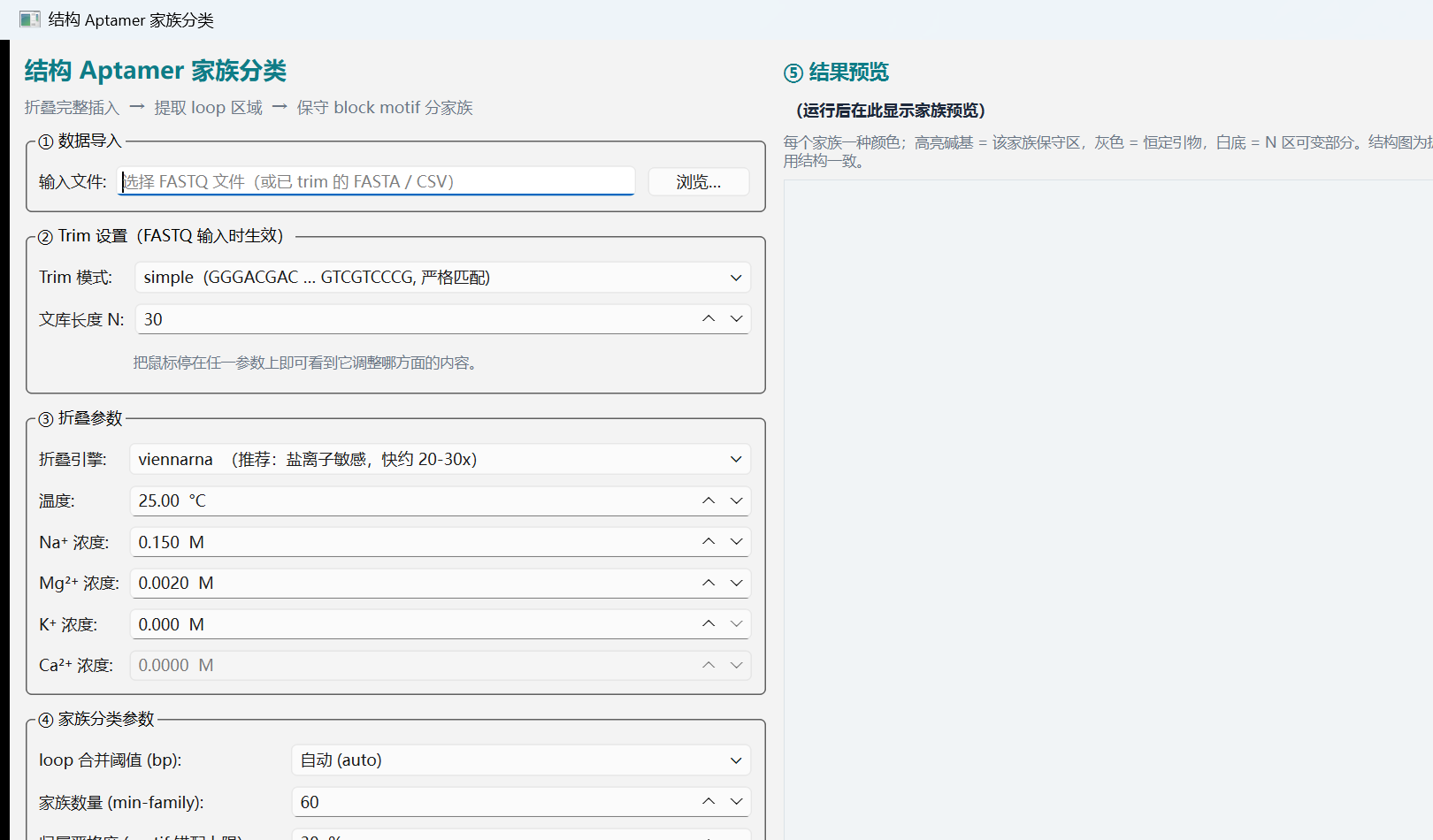
Fig. 01 — Main window -
02
Configure trim, folding & family parameters
In the four parameter panels: pick a trim mode and library length
N; pick a folding engine (viennarnarecommended, salt-sensitive, ~20–30× faster than alternatives); set[Na⁺] / [Mg²⁺] / [K⁺] / [Ca²⁺]and temperature to match your selection buffer; set the loop merge thresholdbp(auto by default), target family count, and motif strictness. -
03
Run the pipeline
Folding (Stage 1/4) is the slow part — every sequence ×
fold_budget≈140constrained refolds, run in parallel across all CPU cores. Stages 2/4 (loop extraction + merge), 3/4 (motif-block classification), and 4/4 (assign + dual-anchor merge + rescue) each finish in seconds once folding is cached. The bottom-left console reports each stage's row counts and the run's headline stats (aptamers, total folds, loop corpus size, families, grouped fraction, representatives).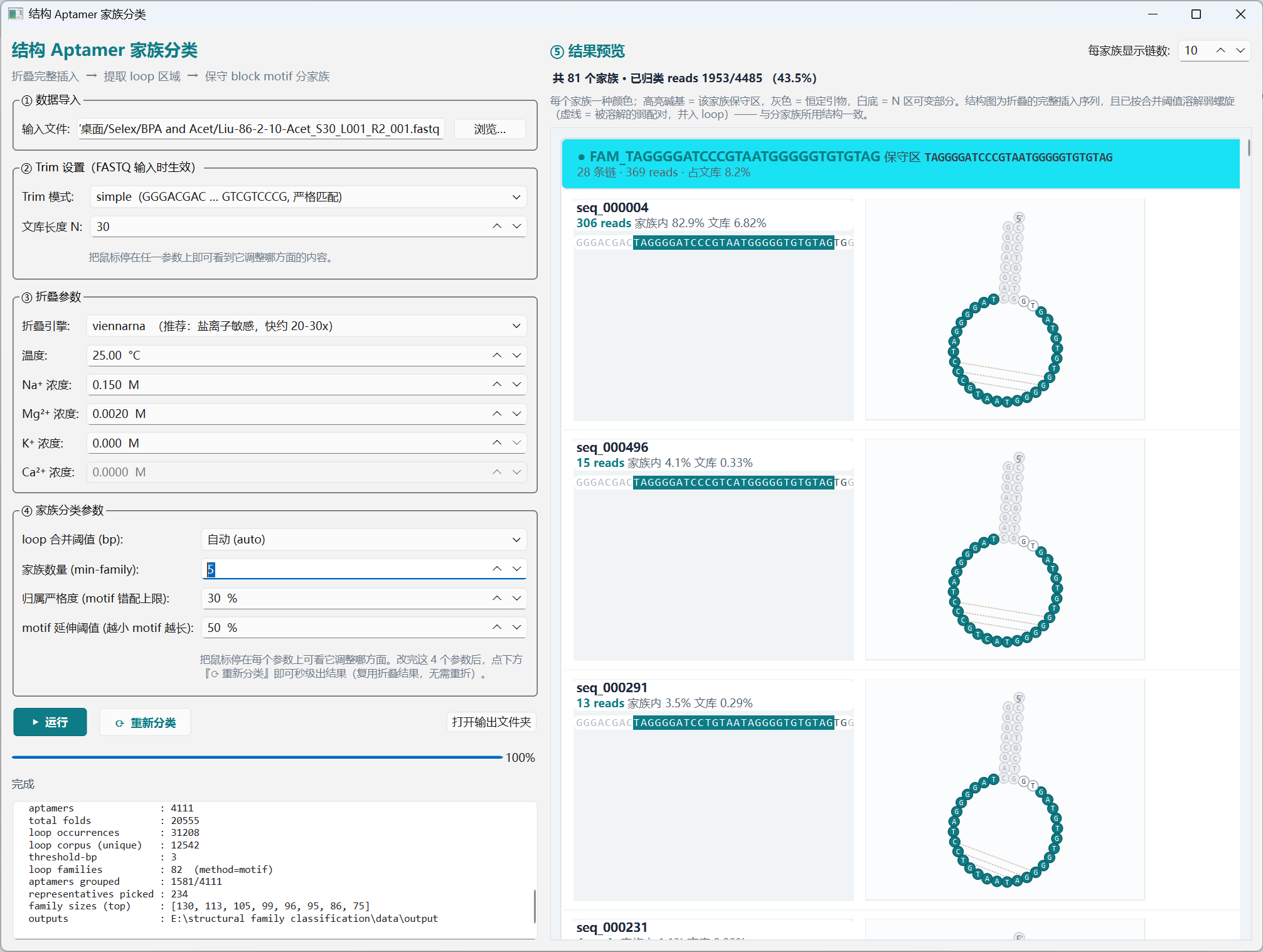
Fig. 03 — Pipeline complete (4111 aptamers · 82 families · 1581 grouped · 234 reps) -
04
Review families & iterate
The result panel renders each family in a distinct colour: highlighted bases = the family's conserved motif, gray = primer flanks, white = variable N region. Each chain card also draws the full-insert 2D secondary structure (dissolved at the merge threshold), with the conserved motif painted in the family colour. Tweak the merge bp, family count (
min-family), motif-mismatch tolerance, or motif-extension cutoff and click Re-classify — the fold cache is reused, so a new family palette appears in seconds.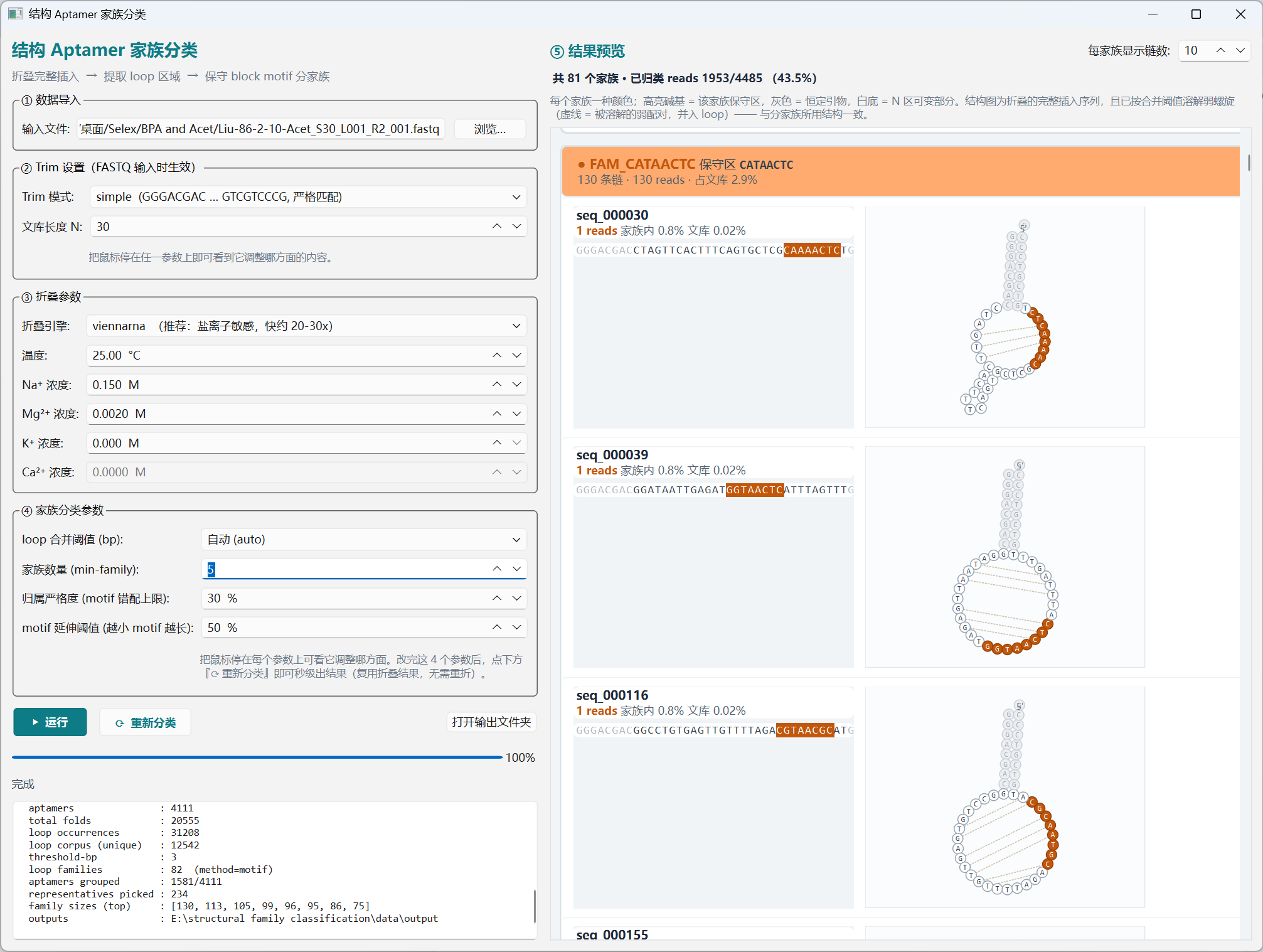
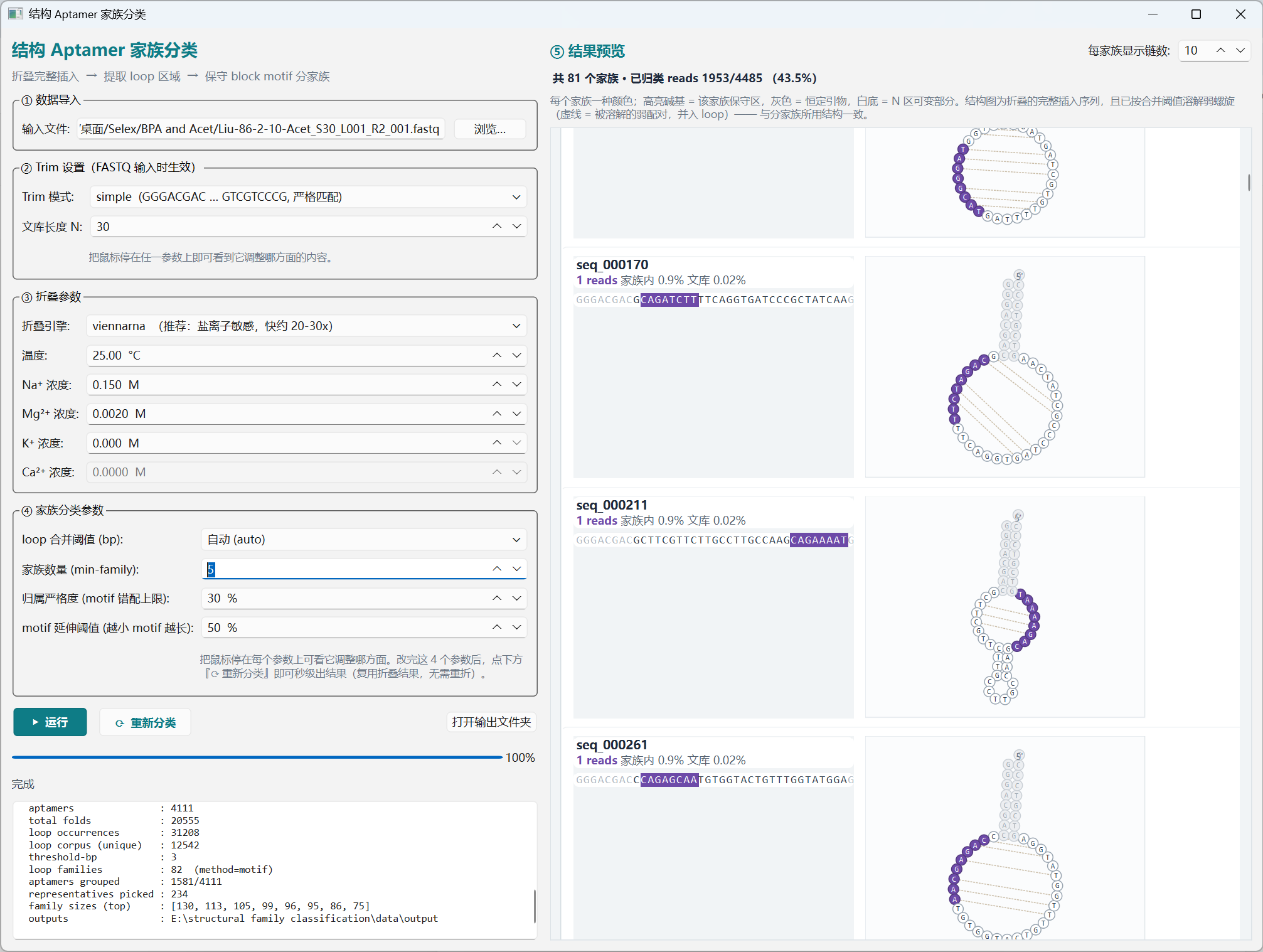
Fig. 04 — Family preview -
05
Export representatives for wet-lab
07_aptamer_family_bp3.csvassigns every aptamer in the pool to a family.08_family_representatives_bp3.csvpicks one representative per family (ranked by read count) — the shortlist you take into CD / ITC / FRET validation.
/ Disclaimer
Things to know.
-
Experimental — a preview build, not yet validated.
Loop-centered family assignment is still an engineering hypothesis. Wet-lab validation (CD melting + ITC across representatives of every family from a real SELEX pool) is ongoing. The build above (v0.9.5) is a usable preview so you can try the pipeline on your own pools — but treat its families as a structure-aware shortlist for triage, not a calibrated, final answer.
-
Folding inherits AptaFold's limits; the classifier is new.
The folding stage reuses AptaFold, so all of AptaFold's accuracy caveats (uncalibrated divalent-cation treatment, experimental engines) apply to the structures this tool classifies. The motif-block classifier, by contrast, is written from scratch for this pipeline — it is not the Aptamer Analysis Tool's k-mer / DBSCAN engine, and its loop-family assignments are themselves the experimental part still under validation.
-
Local processing, no telemetry.
No network calls during the pipeline. Sequences, folds, loops, clusters, and family assignments all live on your machine.
-
Will be free for academic use when released.
Free for academic / non-commercial use, on the same terms as the other Liu Lab tools (MIT-style permissive license). Please point colleagues to this page rather than redistributing the EXE, so they always get the latest preview as the pipeline is calibrated.
-
Provided as-is, without warranty.
Family assignments are best-effort. Treat them as a structure-aware shortlist for wet-lab triage, not as final answers. Bug reports + early collaboration inquiries: [email protected].
/ Acknowledgments
Built with the lab.
Developed in the Bionanotechnology & Interfaces Laboratory at the University of Waterloo, led by Prof. Juewen Liu. This pipeline is the natural sequel to AptaFold and the Aptamer Analysis Tool — taking the question "what families are in a SELEX pool?" from sequence-level matching to structure-level matching.
-

Prof. Juewen Liu
Advisor
Professor of Chemistry at the University of Waterloo. Tier 1 Canada Research Chair in Biosensors & Bionanotechnology. Framed the loop-centered hypothesis and provides the SELEX pools and wet-lab validation pipeline that the families are tested against.
-

Xiaohan Zhang
Author · Pipeline & bridge code
Postdoctoral researcher at the University of Waterloo under Prof. Juewen Liu. Designed the loop-extraction + weak-helix-dissolution bridge, the GUI, and the family-assignment join — wiring AptaFold and the Aptamer Analysis classifier into one structure-aware pipeline.
What is reused, and what is new. Only the folding stage is borrowed. Everything downstream — loop extraction, weak-helix dissolution, the motif-block classifier, and the dual-anchor / rescue post-processing — was written from scratch for this pipeline.
-
Folding — reused from AptaFold
Suboptimal folding via AptaFold's
enumerate_seqfold_suboptimals()— up to 25 structures per sequence within4 kcal/molof the MFE, ranked by ΔG. This is the only borrowed stage; the classifier never recomputes a fold. -
Motif-block classifier — written from scratch
The core engine is original to this project, not the Aptamer Analysis Tool's k-mer / DBSCAN. It mines enriched k-mer cores, grows each into a consensus block, and names a family by the block combination a loop carries — with strict full-consensus membership and no N×N distance matrix. Two original post-processing passes follow: a dual-anchor merge (fuses families that share both a 5′ and a 3′ framework with a variable middle) and an ungrouped rescue (recovers near-identical high-read winners that fall below the motif-seeding threshold).
-
seqfold & ViennaRNA
The two folding engines underneath AptaFold. ViennaRNA is the default in this pipeline for salt sensitivity and runtime; seqfold is the pure-Python fallback when ViennaRNA is unavailable.
Open-source libraries. The pipeline runs on top of these projects — thanks to their maintainers:
- seqfold
- ViennaRNA
- NumPy
- matplotlib
- PySide6
The motif-block classifier itself uses only the Python standard library — no clustering dependency.
/ FAQ
Questions people actually ask.
-
How is this different from clustering sequences directly?
Conventional post-SELEX clustering matches aptamers by full-length string similarity, which conflates "same fold, different stem" cases. This pipeline compares the loop region after weak-helix dissolution instead, so two aptamers with different stems but the same loop architecture land in the same family.
-
What is weak-helix dissolution?
Helices of 3 base pairs or fewer are dissolved, which lets the loops flanking them merge into a single larger loop. The rationale is that very short helices are marginally stable and should not be treated as hard boundaries between loop regions.
-
Does it use only the minimum-free-energy structure?
No — each sequence is folded into up to 25 suboptimal structures, and loops are extracted from each of them. Using a structure ensemble rather than a single MFE prediction is what makes the family assignment robust to near-degenerate folds.
-
How are the merged loops grouped?
By a purpose-built conserved-motif classifier written from scratch for this task — not a reuse of the Aptamer Analysis Tool's k-mer / DBSCAN engine. Whole-loop string distance was rejected because it dilutes a short conserved core inside a long variable loop.
-
How far should I trust the output?
Treat it as a structure-aware shortlist, not a conclusion. The tool is marked experimental and the loop families are still under wet-lab validation.
/ Citation
How to cite.
If this tool contributed to work you are publishing, a citation is the most useful thing you can send back — it is what keeps the tool maintained and lets other people find it.
APA
Zhang, X. (2026). Structural Family Classification (Version 0.9.5) [Computer software]. https://aptapilot.com/tools/structural-family-classification/
BibTeX
@software{zhang_structural_family_classification_2026,
  author  = {Zhang, Xiaohan},
  title   = {Structural Family Classification},
  year    = {2026},
  version = {0.9.5},
  url     = {https://aptapilot.com/tools/structural-family-classification/}
}
/ Also in the toolkit
Other tools.
 Desktop · Windows + macOS
Aptamer Analysis Tool
Sibling SELEX tool — sequence-level family clustering by k-mer + DBSCAN. This pipeline takes the loop-family question its own way, with a self-written motif classifier.
 Desktop · Windows · Single-file
AptaFold
Four-cation aware DNA aptamer folding. Provides the suboptimal-folding engine this pipeline reuses.
 Web · Online
Kd Fitting Tool
Quadratic binding-model Kd fitting from concentration / signal data. Browser-only, no upload.